










Before new steel ends up in a car, it has already been on the road for a year
And we do not mean the physical journey to the car manufacturer, but the trial coils, laboratory tests, customer discussions and extensive checks that take place first. Step by step, these checks establish whether the steel does what car manufacturers expect from it.
When you see a car on the road, you probably do not immediately think of trial coils, corrosion tests or how well steel can withstand cracking around the edge of a hole. In the Hole Expansion Test, a hole is first punched into a steel sheet. That hole is then gradually stretched further until a crack appears at the edge. This shows how much local formability the steel can handle when a part with punched holes or trimmed edges is being made.
Behind every piece of automotive steel lies a careful testing process. Especially now that we are working on a new way of producing steel with a lower environmental impact, that preparation is very important.
Car manufacturers do not simply switch to new steel. First, they need to be able to demonstrate that the material is strong enough, can be formed properly, remains safe and fits into their own production process.
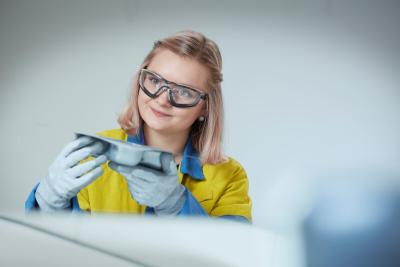
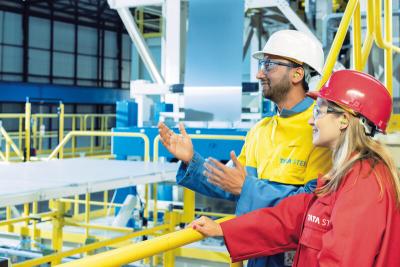
Ingrid knows all about that. She works in Customer Technical Service for automotive: the department that forms the technical bridge between Tata Steel and car manufacturers. Together with colleagues in, among other countries, the Netherlands, Germany, Sweden, Turkey, the Czech Republic, France and Spain, she is the point of contact for customers when it comes to technical questions, testing programmes and approvals. That international character suits her well; Ingrid is from Barcelona herself and has been working in the Netherlands for years.
No simple tick on paper
"Homologation is the word we use in the automotive world for an approval process," says Ingrid. That may sound like getting a tick on paper, but it is anything but that.
Tata Steel first tests the material itself. Customers then also carry out tests in their own laboratories. If those steps have gone well, a trial coil is used and a formal approval follows.
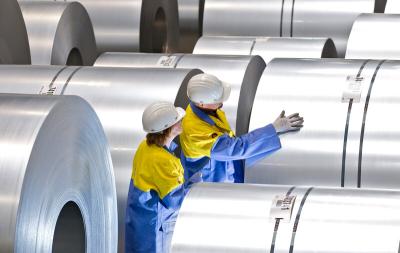
"From the moment you say: we are going to start this today, until it is approved, it can take a year," Ingrid explains. A year of preparing trials, producing coils, cutting sheets, sending samples to laboratories and measuring properties. Some tests, such as corrosion tests, take months. And if a customer has additional requirements, the steel or the process sometimes has to be adjusted again.
A piece of steel is put through its paces
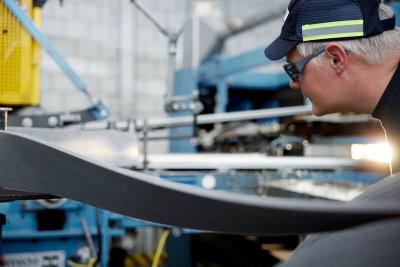
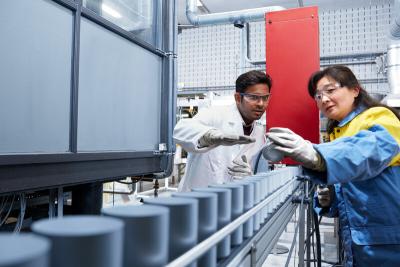
The tests all differ. In a tensile test, for example, a small piece of sheet steel is pulled apart in a machine to measure how much force it can withstand and how far it can elongate before it breaks. The chemical composition, microstructure, zinc layer, coating adhesion, surface quality and formability of the steel are also examined.
‘Some tests are surprisingly practical. Cars have rounded shapes, sharp edges, openings, flanges, trimmed edges and connections with other materials. That is why one of the tests that are carried out aim to see how far a hole in steel can be stretched without the material tearing. It is also tested whether steel can be bonded properly to other materials, such as aluminium or plastic. "In a car, you have plastic, steel and aluminium. Sometimes you get a kind of sandwich of different materials that all have to stay bonded together."
Why car manufacturers are extra critical
The bar is high everywhere, but especially in automotive. Steel in cars has to be strong, but often also thin and lightweight. It has to absorb energy in a crash and remain formable during production. At the same time, car manufacturers are under pressure themselves: they need to control costs, improve the performance of their end products and meet stricter requirements around sustainability and CO₂ emissions. That is why customers do not only check whether a steel grade meets the standard on paper, but also whether the quality is high and consistent enough from coil to coil. The ability to meet those expectations is therefore an important factor when choosing a supplier.
The transition starts before the furnace is there
The switch to steel from an electric furnace also requires a great deal of preparation. The Electric Arc Furnace is on our agenda, but it is not yet in place. Waiting until it is ready is not an option. That is why we are already carrying out trials with material that resembles as closely as possible the steel that will later be produced via the new route. We have looked at the expected chemical composition, the use of scrap and the influence of residual elements: elements that come from scrap and cannot simply be removed from the steel.
When the new production route starts, the material must be suitable for customers as quickly as possible. "Our customers expect a good product – just as good as it was – but produced via a route with a lower environmental impact," says Ingrid. That requires new installations and preparation in laboratories, plants, customer teams and at the car manufacturers themselves.
From IJmuiden to Europe
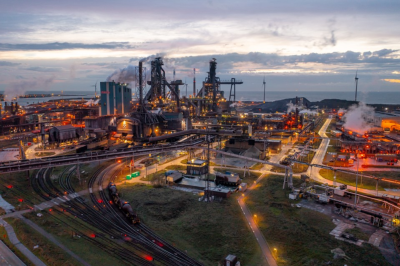
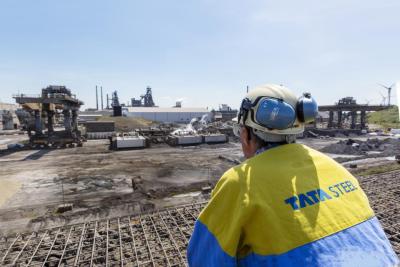
The steel transition is therefore not only taking place on our site in IJmuiden. It extends into customers’ laboratories and factories across Europe. Automotive customers have their own goals, timelines and testing programmes. At the same time, we as a steel producer have our own transition path. Ingrid calls it "a bit of a chicken-and-egg story": everyone wants to move forward, but everyone also needs to be sure the whole chain is moving with them.
That is why we discuss our plans with customers years in advance, so that no one is caught by surprise. Needs differ per customer and per steel grade. Ingrid and her colleagues provide technical explanations, align on testing and, above all, help build the trust needed to take the next steps together.
Trust is just as important as technology
Ultimately, this is not only a technical story. Of course it is about properties, standards, tests and process settings. But trust is just as important. "It is all about trust," says Ingrid. "First you have to earn that trust." Customers need to be able to rely on Tata Steel to be transparent, communicate early and work with them to find the best way forward.
That makes clear just how much happens before new steel ends up in a car. By then it has already been tested, calculated, aligned, adjusted and checked again. And it shows exactly what the transition in steel production is about: not that steel itself automatically becomes ‘cleaner’, but that it is made via a route with a lower environmental impact. That requires more than a different furnace. It requires a whole chain of people, departments and companies working together to ensure steel is produced in a different way while still doing exactly what it needs to do.