











Insight into every scrap load within minutes
A fully loaded truck of scrap metal enters a tunnel, and within minutes we know exactly what it contains. No complex logistics, no unloading required. That is the power of LIBS: a technology that scans an entire load using up to 1,000 measurements per second, providing immediate insight into its composition. What was once based on estimation is now backed by hard data—fast, accurate, and fully automated.
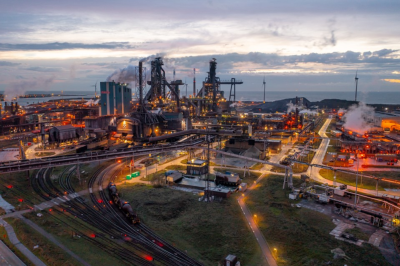
“What we are doing here in IJmuiden is making the invisible visible. Nothing like this exists anywhere else in the world. This is truly state-of-the-art,” says Frank Schrama, Principal Researcher at Research & Development and the driving force behind the idea.
From laser to data
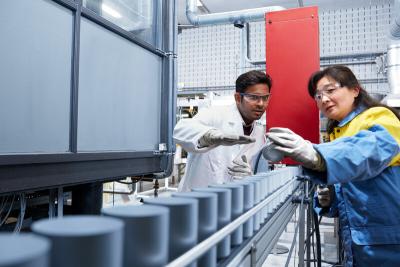
LIBS stands for Laser-Induced Breakdown Spectroscopy. It may sound complex, but the concept is surprisingly straightforward. A highly precise laser is directed at the scrap, vaporizing tiny particles of material. This creates plasma—a glowing cloud of ionized gas. By analyzing the light emitted by this plasma, it is possible to determine exactly which elements are present.
Frank explains: “To focus the laser with extreme precision, we use a mirror derived from space technology. It is one of the purest mirrors in the country, with a level of purity normally found only in satellites.”
Scanning without unloading
While traditional methods analyze only small samples of scrap on a conveyor belt, this innovation assesses entire, unsorted loads. “The truck drives into a high-tech tunnel, where the load is scanned without being unloaded,” Frank explains.
This saves time and makes the process significantly more efficient.
Combining laser technology and AI
The technology becomes even more powerful when combined with AI-enabled cameras. These cameras identify shapes, structures, and materials, and combine that information with the laser data. The result is a complete and reliable picture of the entire load.
“We perform up to 1,000 measurements per second. That allows us to know in real time exactly what a shipment contains,” says Frank.
Essential for more sustainable steel
Why is this so important? Scrap plays a crucial role in the production of more sustainable steel, and we aim to increase the amount of scrap used in our processes. However, scrap can sometimes contain unwanted materials, such as copper or even remnants of car tyres. These contaminants can affect the quality of new steel.
“To meet our high quality standards, we need to know the exact composition of the scrap,” says Frank. “With the LIBS portal, we will be able to determine that immediately upon arrival.”
Next steps
The technology was successfully tested at our IJmuiden site in March, and the initial results are promising. Later this year, a temporary, simplified portal will be introduced, with a full-scale permanent version expected around 2029.
One thing is certain: the future of steel will not only be greener, but also much smarter—and it starts with what we can already see today.
European collaboration
The LIBS portal is part of the European DiGreeS project, which focuses on making steel production greener. Various European partners are collaborating on this initiative, including Spectral Industries, BFI, K1-MET and SZTAKI. Fraunhofer, Voestalpine and Saarstahl are also participating in the DiGreeS project.
With support from the European Union, we are working together to develop innovative technologies for the steel industry of the future.